
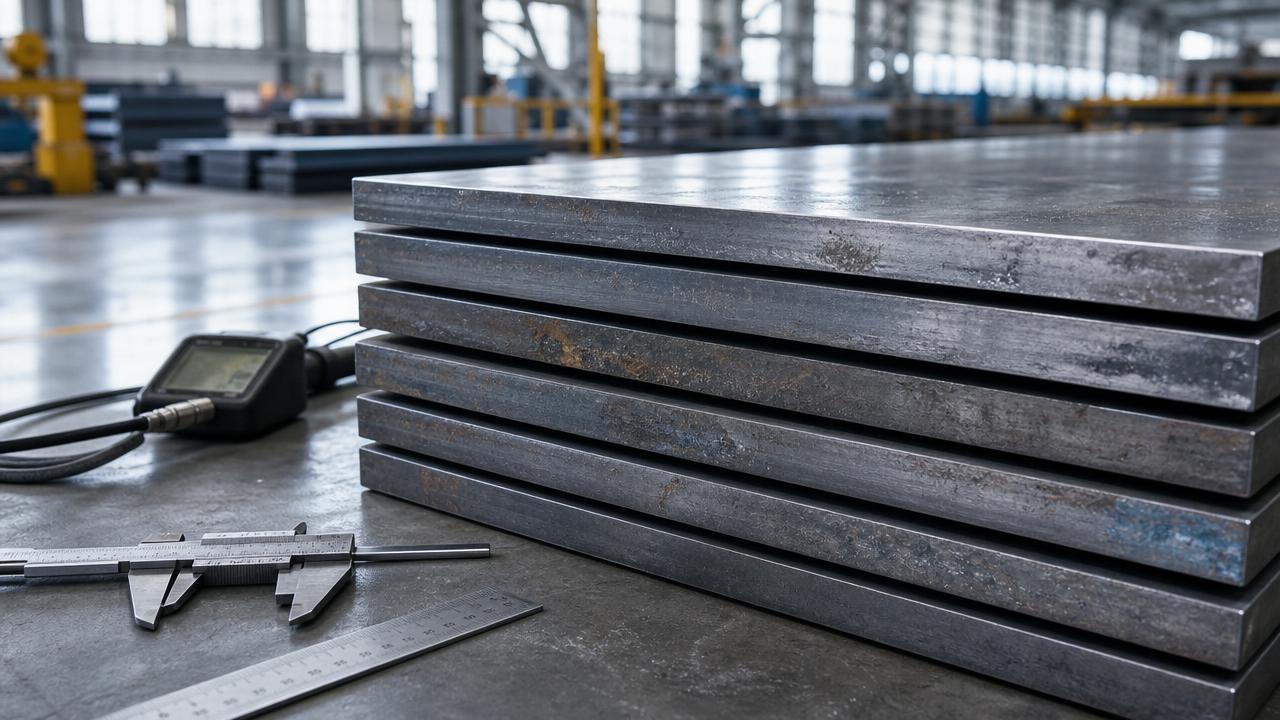
Before any carbon steel plate enters fabrication, inspection, or load-bearing service, quality control and safety teams must identify defects that could compromise performance, compliance, and workplace safety.
Surface flaws, dimensional deviations, lamination, rust, and hidden internal issues can lead to costly rework or serious operational risks.
This guide outlines the key carbon steel plate defects to check before use, helping inspection teams make informed acceptance decisions and support safer steel applications.
What Defects Should Be Checked First on Carbon Steel Plate?
The first inspection should focus on visible defects, because many service risks begin with surface condition and handling damage.
A carbon steel plate may look acceptable from a distance, yet show cracks, pits, dents, or edge damage during close examination.
Surface inspection is especially important before cutting, welding, bending, machining, coating, or pressure-bearing use.
Common visible defects include scratches, gouges, scabs, rolled-in scale, rust patches, edge cracks, and mechanical impact marks.
Light marks may be acceptable for general structural use, depending on standards, tolerance, and final application requirements.
Deep defects are different. They may reduce effective thickness and create stress concentration points during service.
- Check both faces of the carbon steel plate under sufficient lighting.
- Inspect edges, corners, lifting points, and stacked contact areas carefully.
- Mark suspicious areas for dimensional measurement or further testing.
- Compare defect depth with applicable purchase specifications.
For critical fabrication, visual inspection alone is not enough. It should be supported by measurement, documentation, and suitable testing.
Why Are Cracks, Gouges, and Edge Defects Serious?
Cracks are among the most serious defects in carbon steel plate because they can grow under stress, vibration, or thermal cycles.
Even short cracks can affect welding quality, fatigue resistance, and safety margins in structural or equipment applications.
Edge cracks often appear after shearing, flame cutting, rolling stress, or improper handling during transport.
Gouges and deep scratches also require attention. They may become crack initiation points after forming or repeated loading.
A carbon steel plate intended for bridges, machinery bases, tanks, or welded structures should have stricter crack acceptance criteria.
If cracks are suspected, magnetic particle testing or ultrasonic testing may be needed, depending on thickness and application.
How should suspicious cracks be handled?
Do not grind or repair the area before recording the original defect condition and location.
Measure length, orientation, and depth where possible. Then confirm whether repair is allowed by the governing standard.
Some defects can be removed by grinding if remaining thickness stays within tolerance.
However, through-thickness cracks, clustered defects, or cracks near weld zones usually require rejection or technical review.
How Can Lamination and Internal Defects Be Detected?
Lamination is a hidden defect where layers inside the carbon steel plate separate or fail to bond properly during rolling.
It may not be visible on the surface, but it can reduce through-thickness strength and welding reliability.
Lamination risks are important for pressure vessels, shipbuilding parts, heavy equipment, structural nodes, and thick welded components.
Internal defects may include inclusions, voids, segregation bands, and rolled-in discontinuities inside the steel matrix.
A carbon steel plate used for ordinary covers may tolerate minor internal imperfections.
The same defect may be unacceptable in pressure-bearing or high-impact service.
Which inspection methods are commonly used?
Ultrasonic testing is widely used to find lamination and internal discontinuities in medium and thick plate.
Cut-edge examination may also reveal layered separation after cutting or beveling.
For critical projects, inspection certificates should specify test standards, acceptance levels, and tested areas.
When buying carbon steel plate for demanding fabrication, request traceable quality documents before shipment or release.
What Dimensional Problems Affect Carbon Steel Plate Use?
Dimensional accuracy affects fabrication efficiency, assembly quality, welding gaps, material yield, and finished product reliability.
A carbon steel plate should be checked for thickness, length, width, flatness, squareness, and edge condition.
Thickness deviation is particularly important because design strength calculations usually depend on minimum plate thickness.
If actual thickness is below tolerance, load capacity, corrosion allowance, or machining allowance may be insufficient.
Flatness problems can cause poor fit-up, uneven welding stress, machine alignment issues, and increased processing time.
Camber, waviness, and local bulging should be measured according to project requirements and relevant steel standards.
What should be measured before acceptance?
- Thickness at multiple points across the carbon steel plate.
- Length and width against purchase order tolerances.
- Diagonal dimensions to confirm squareness.
- Flatness using straightedge, level tools, or approved gauges.
- Edge quality after shearing, flame cutting, or plasma cutting.
Dimensional inspection should be recorded clearly, especially when carbon steel plate is prepared for CNC cutting or welded assemblies.
How Much Rust or Scale Is Acceptable Before Use?
Rust is common during storage and transport, but its severity determines whether the carbon steel plate remains suitable.
Light surface rust can often be removed by blasting, brushing, grinding, or pickling before coating.
Heavy pitting corrosion is more serious because it reduces local thickness and creates uneven stress distribution.
Mill scale also needs review. Loose scale may affect painting, galvanizing, welding, and adhesive performance.
If a carbon steel plate will be coated, surface preparation standards should be confirmed before processing starts.
For outdoor structures, marine parts, tanks, and industrial equipment, corrosion defects require stricter evaluation.
What are practical rust assessment steps?
- Identify whether rust is superficial, layered, or pitted.
- Clean a small area to reveal the base metal condition.
- Measure remaining thickness where pitting appears deep.
- Confirm surface preparation grade for coating or welding.
- Reject or downgrade plate if corrosion exceeds specification.
Rust evaluation is not only cosmetic. It directly affects service life, coating adhesion, and maintenance cost.
Which Documentation and Traceability Checks Matter?
A physical inspection is incomplete without checking documentation, markings, and traceability records.
Every carbon steel plate should match the purchase order, grade, size, heat number, standard, and delivery condition.
Material certificates should include chemical composition, mechanical properties, heat treatment status, and inspection results.
If certification data does not match plate markings, the material should be isolated until the issue is resolved.
Traceability is especially important for carbon steel plate used in export projects, regulated equipment, or safety-critical structures.
Liaocheng Jinchang Xincheng Trading Co., Ltd. supports customers with stable supply, product matching, and steel quality coordination.
The company provides carbon steel and stainless steel products to global markets, with experience serving key regions such as Russia.
What should be verified before release?
- Grade designation and applicable standard.
- Heat number and batch traceability.
- Thickness, width, length, and quantity.
- Mechanical properties and chemical composition.
- Ultrasonic, surface, or third-party inspection records, if required.
Carbon Steel Plate Defect Check FAQ Table
How Should Acceptance Decisions Be Made?
Acceptance should combine defect severity, application risk, applicable standards, and repair feasibility.
A cosmetic defect on non-critical carbon steel plate may not affect performance.
The same defect on pressure equipment, welded joints, or load-bearing parts may be unacceptable.
Avoid judging defects only by appearance. Measure, test, compare, and document before release.
When uncertainty remains, technical review is better than risking rework, delayed delivery, or field failure.
Reliable suppliers can help reduce defect risk through stable sourcing, inspection coordination, and clear documentation.
Before using any carbon steel plate, inspect surfaces, dimensions, corrosion, internal quality, and certificates together.
For project-specific carbon steel plate requirements, confirm grade, tolerance, testing needs, and delivery condition before ordering.
Liaocheng Jinchang Xincheng Trading Co., Ltd. can support dependable steel supply and practical product selection for global customers.
Leave A Message
If you are interested in our products and want to know more details, please leave a message here, we will reply you as soon as we can.